
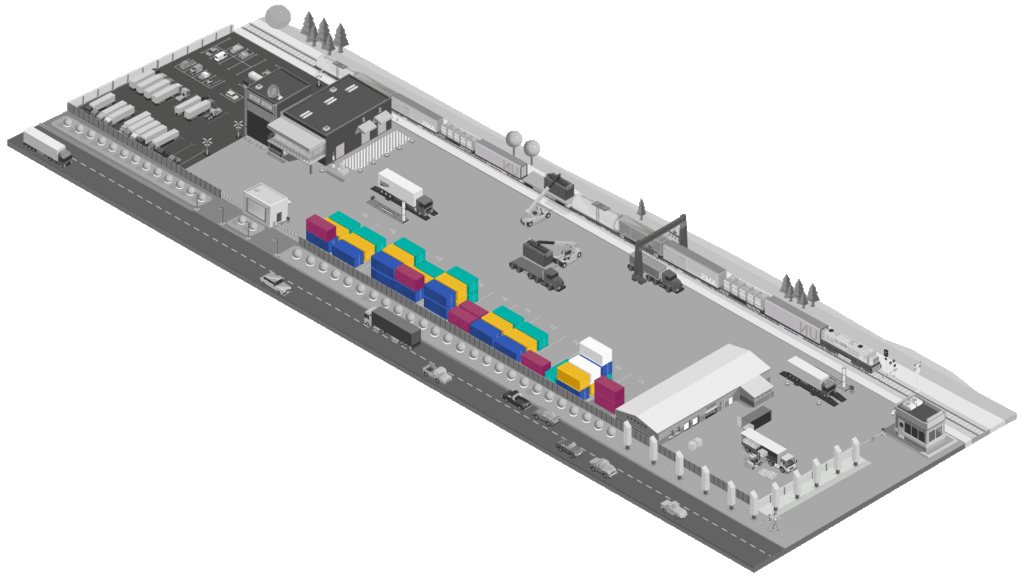
Essentos Depot is the module that governs container storage end to end—a single, dependable system of record for what’s in the yard, exactly where it sits, and what should happen next. It centralizes the inventory of full and empty containers, the yard layout and disposition, and the logic of zones, lanes, stacks, and tiers/slots, delivering real-time operational visibility for every unit.
Depot runs on a precise location model and enforces physical and safety constraints such as maximum heights, type compatibility, weight classes, hazardous goods (HazMat), reefers and powered racks, and restricted areas. Every move that affects location is recorded with timestamp, user, equipment, and evidence (reads/photos/signatures), so the system state mirrors the physical yard.
In plain terms: Depot gives terminals, inland depots, and rail ramps fine-grained control over storage. You always know what you have, where it is, and the next best action to hit departure windows, prioritize customers, protect critical lanes, and eliminate non-productive moves. Within Essentos, Depot functions as the container storage and yard management module—clear, auditable, and built for high-throughput operations.
What Depot is (and isn’t)
- Is: The authoritative ledger of inventory and slot-level location, plus the rules engine that places, protects, and proves every move.
- Is not: A spreadsheet, a radio channel, or a black-box optimizer; every rule is explicit, evidence-backed, and aligned with your safety and service policies.
Why Depot?
A terminal’s actual capacity is how well it uses and recovers space, not just acres on a site plan. When coherence slips, rehandles, queues, and long searches increase; lanes get blocked; and service levels degrade. Depot acts as the storage “brain” that keeps the layout organized, reserves critical lanes, enforces segregation, and places containers with exit-driven logic tied to customer commitments and train/berth windows.
By moving information off spreadsheets and radio calls into a shared, trustworthy inventory for Operations, Planning, and Customer Service, Depot reduces discrepancies, cuts dwell, raises shift productivity, and shortens audits and disputes—because every location change has a traceable trail.
How does it work?
- Entry & record creation. Depot receives entry authorization from Fastport and creates/updates the container record with its initial location.
- Placement rules. Configurable rules consider cargo type, customer, next departure, weight class, compatibility, and safety restrictions to assign the right slot the first time.
- Execution & confirmation. When Operations unloads or repositions, Depot validates prerequisites, assigns the target location, and updates the final position with capture evidence so inventory stays accurate.
- Special handling & blocking. Reefers get powered rack assignment and monitoring; hazardous cargo is segregated to compliant zones; inspections are routed to designated areas. Moves that violate rules or reservations are blocked.
- Status to your ecosystem. In parallel, Connect publishes status so ERP, WMS, PCS, ocean carriers, and Customs see the same ground truth as Operations, reducing calls and preventing mismatches.
Key capabilities
- Exact, slot-level inventory by container number with current operational state.
- Yard modeling: Zones, lanes/aisles, stacks, tiers/slots; capacity and height limits; area reservations for pre-staging, high-turn lanes, and shift buffers.
- Exit-oriented placement to reduce rehandles and travel time; filters by type, size, weight; exception handling for HazMat and powered reefers with monitoring.
- Fast retrieval & views: query by customer, booking, range, or status; visual heat maps of occupancy and dwell; utilization metrics; reorg suggestions when they pay off.
- End-to-end traceability for audits and customer care: photo evidence, automated reads, signatures, users, equipment, timestamps.
Native integrations
- Fastport: Appointments, document validation, and gate-in to open or update the record.
- AI Reader: License-plate and container reads as evidence of passage and location.
- Weighing: VGM and weigh tickets where applicable; can constrain allowed zones by weight.
- Securepass: Identities and permissions for restricted yard areas.
- Connect: Syncs status with ERP, WMS, PCS, ocean carriers, and Customs, publishes CODECO, and consumes pre-advices/releases so storage executes to plan.
- Operations & Analytics: Operations executes tasks and confirms location; Analytics tracks occupancy, zone dwell, rehandles, and shift productivity.
Use cases
- Import surge recovery. Restore coherence with exit-driven rules; reserve lanes for upcoming truck pickups and zones for train pre-staging.
- Hazardous-goods compliance. Assign only valid locations; block unsafe transfers automatically.
- Reefer certainty. Place in powered racks with monitoring and alerts on outages or tolerance breaches.
- Export readiness. Pre-stage by train or berth window; reserve areas to avoid last-hour congestion.
- Rapid inspections. Locate any container in seconds because the ledger matches the physical yard.
Measurable benefits
- Fewer rehandles via consistent placement rules and lane reservations—eliminating moves without value.
- Lower dwell by aligning storage to the next departure and avoiding dead zones.
- Higher shift productivity from shorter search and travel paths, guided by an organized layout and reliable data.
- Near-100% inventory accuracy with event-based capture and evidence.
- Faster audits & dispute resolution with photos and timestamps for every location change.
Practical example
A truck arrives with two imports and one export. Fastport confirms access and documents; Weighing records VGM if required. Operations unloads the first import; Depot proposes a slot in a priority pickup zone based on the customer’s time window. The second import goes to a longer-dwell area because it has no immediate exit. The export is moved to pre-staging tied to a late train window. AI Reader confirms captures and seals the final positions. Connect publishes status to the PCS and ERP, and Analytics updates occupancy and dwell by zone. At shift close, the supervisor reviews the heat map and accepts a reorganization suggestion that frees a critical lane for the next morning.
Who uses Essentos Depot?
- Marine & river terminals needing reliable inventory, pre-staging by vessel window, and pier/rail coordination.
- Inland depots & rail ramps that must turn trucks fast, protect critical lanes, and keep stacks coherent during surges.
- 3PLs & large shippers operating private yards who need traceability for audits, Customs, and customer SLAs.
- Cold chain & hazardous cargo handlers where power, monitoring, and segregation rules are non-negotiable.
Deployment & security
Essentos supports on-premises or hybrid deployment for enterprise IT. Access is controlled through roles and permissions, with full audit trails tied to users, equipment, time, and evidence. Connect exposes modern APIs and standard EDI (incl. CODECO) so Depot shares one truth across your systems and partners.
KPIs Essentos Depot helps you track
- Yard occupancy and utilization by zone/stack.
- Dwell time distributions and heat maps.
- Rehandles per shift / per container / per area.
- Lane reservation effectiveness (blocked conflicts avoided).
- Inventory accuracy and exception rates.
Task completion and shift productivity trends.